Live swell data
for every coast
of the island.
Three solar-powered wave buoys, one for each swell window, publishing every reading free within minutes. Phase 1 puts the first buoy off Soup Bowl in 2027.
Forecasts without
a measurement to check against.
Every public surf, fishing and marine forecast for Barbados is a computer model. Global models are good in open ocean but weak over the last few kilometres, where swell bends around the island and meets the reef. The readings that do exist stay inside the agencies that collect them.
Three buoys.
Four coasts covered.
Every swell that reaches Barbados comes from the east, the north or the south. Each window gets its own buoy, moored outside the surf zone on flat ground in 36 to 44 m of water, 1.3 to 2.1 km offshore, placed on the government's seabed survey.
No west coast buoy is needed: west coast surf is north swell that has already passed Maycocks, so buoy 02 reads it first.
36 to 38 m terrace, 1.5 to 1.8 km north-east.
36 to 38 m shelf below the drop-off, 1.9 to 2.1 km west-south-west.
42 to 44 m basin beyond the wall, 1.3 to 1.5 km south-south-east.
Contours every 2 m, 30 to 40 m in blue. Orange marks the proposed mooring on flat ground; each is confirmed by a dive before the anchor goes down.
Research-grade data
at a fraction of the cost.
Each site uses a Sofar Spotter: a 42 cm, 7.5 kg solar-powered wave buoy. In a year-long side-by-side study it matched a research-grade Datawell buoy to within 6 cm on significant wave height, at about a tenth of the price.
- Wave height
- Within 10% or 0.1 m
- Period and direction
- Full directional spectrum
- Sea temperature
- To within 0.1 °C
- Air pressure
- To within 0.5 mbar
- Power
- Five 2 W solar panels
- Data link
- Mobile network, satellite backup
Manufacturer figures; wind is derived from the waves.
- Spotter buoy
- Ballast chain and bow shackle, supplied
- Surface floats, two
- 300 mm trawl floats, 10 kg lift each
- Swivel
- 316 stainless, forged, 8 mm minimum
- Riser line
- 1.2 to 1.5 times the depth, 10 mm line
- Chain, 5 m
- 6 mm 316 stainless
- Anchor
- 70 kg holding force, one clump
Held by a double catenary mooring: two slack loops let the buoy follow every wave, so the mooring never pulls it under or distorts the reading.
One buoy first.
Then the network.
Soup Bowl goes in during the late-April to June 2027 lull and runs as a public beta through the hurricane season. Each later buoy is bought only once the one before it has proved itself.
- Deploy
- April to June 2027
- Gate
- Review end of October 2027
- Launch cost
- BBD 46,996
- Deploy
- November 2027
- Gate
- Review March 2028
- Launch cost
- BBD 26,236
- Deploy
- April to June 2028
- Gate
- Full network review
- Launch cost
- BBD 26,236
Pass all four and the next buoy is ordered. Fall short, and the beta is fixed before another buoy is bought.
BBD 46,996
puts the first buoy in the water.
Phase 1 buys and installs the Soup Bowl buoy, keeps a spare on island so the site never goes dark, and builds the public data platform.
A year: data transmission, cleaning every 6 to 8 weeks, rigging, insurance and reserve. No salaries.
| Item | BBD |
|---|---|
Soup Bowl buoy, installed Spotter, mooring, freight, duty, VAT, vessel and dive team | 22,134 |
Spare buoy on island Swapped in during cleaning or repair | 17,708 |
Survey, permits and platform Site survey, CZMU permit, public website and data feed | 1,600 |
Contingency and card fees 10% contingency, 3% on donations | 5,554 |
| Phase 1 total | 46,996 |
All figures in Barbados dollars. Full three-phase network: BBD 99,468.
Built for surfers.
Useful to everyone on the water.
Put the first buoy
in the water.
Every dollar goes to Phase 1: the Soup Bowl buoy, its spare and the open data platform. Donors are listed below unless they choose to stay anonymous.
Be the first name on the list.
About USD 125. Payments are processed securely by Stripe in Barbados dollars.
Funds are held for the Fluctus project and reported quarterly. If Phase 1 is oversubscribed, the balance goes to Phase 2.
Put your name
on the sea.
Businesses and organisations that rely on the water can back the network directly. Partner names appear on the live readings everyone checks.
Your name or logo on the supporters wall.
- Name or logo on the partners wall
- Logo on that buoy's live readings page
- Quarterly data and impact report
- Buoy named for you on site and in the API
- Invitation to the deployment day
Keeps one buoy reporting for a year, under your name.
- Name or logo on the partners wall
- Logo on that buoy's live readings page
- Quarterly data and impact report
- Buoy named for you on site and in the API
- Invitation to the deployment day
Installs one complete buoy, named for you for its working life.
- Name or logo on the partners wall
- Logo on that buoy's live readings page
- Quarterly data and impact report
- Buoy named for you on site and in the API
- Invitation to the deployment day
Buoy partner is an annual commitment; renewal is invited each year. Founding buoy naming lasts for the buoy's working life.
The first partners will be listed here.
Every number,
every source.
The full proposal covers the equipment, sites, mooring design, deployment procedure, budgets, data model, approvals and risks, with 27 sources.
Download the proposal, PDF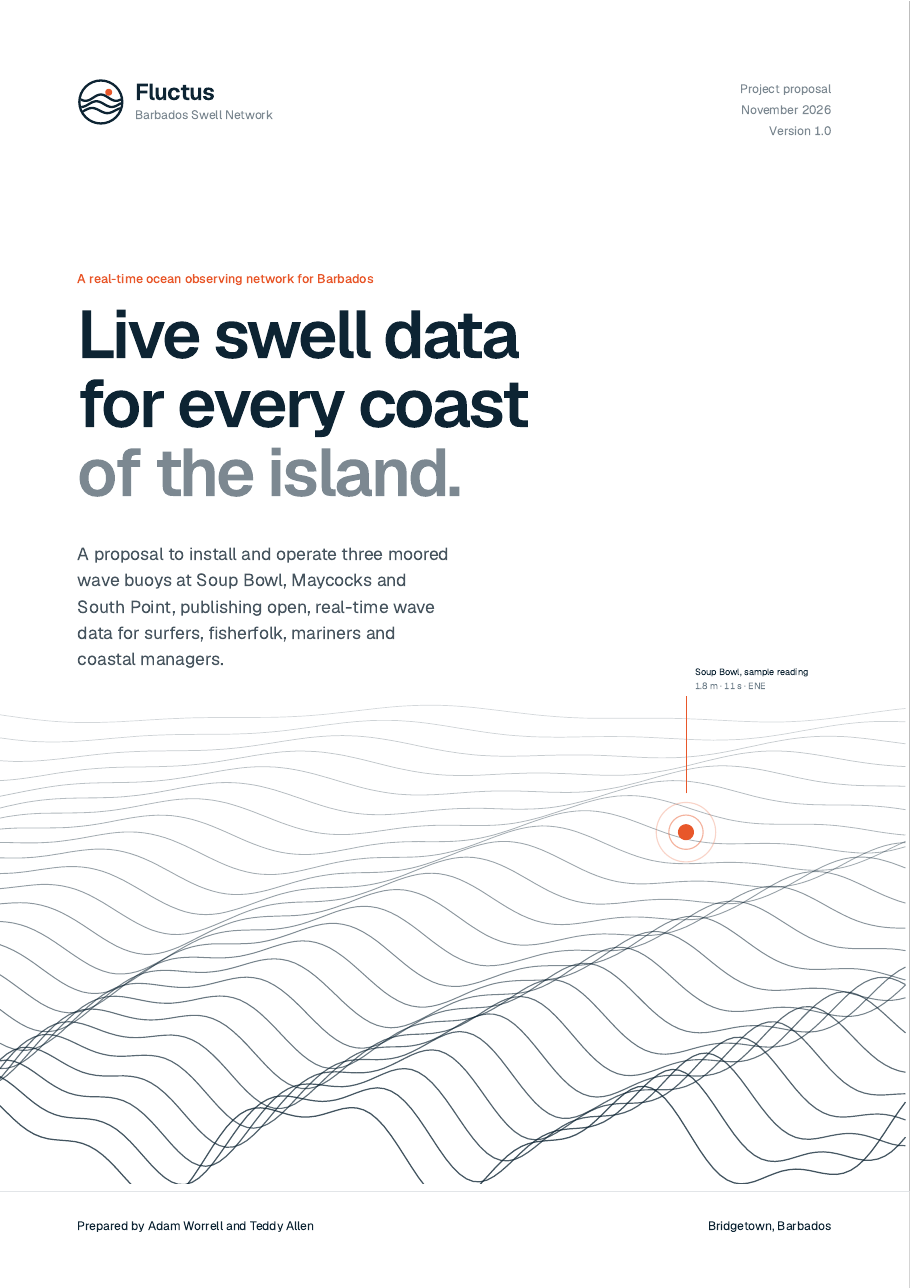
Before you
give.
Will the data really be free?+
Yes. Live readings and seven days of history are free to everyone, for good. Businesses that build services on the data pay for the API, and that income keeps the buoys running.
Why start with one buoy?+
Soup Bowl is the most demanding coast to service. A mooring and a routine that survive a hurricane season there will work anywhere on the island, and every later buoy is bought only after the one before it passes its review.
What happens in a hurricane?+
Buoys are recovered before named storms when it is safe to do so. A spare is held on island, and a replacement reserve builds every year.
Is this approved?+
Positions are agreed with the Coastal Zone Management Unit, Barbados Port Inc., the Fisheries Division and the Coast Guard before any buoy goes in.
Where does my money go if Phase 1 is fully funded?+
Straight to Phase 2, the Maycocks buoy.